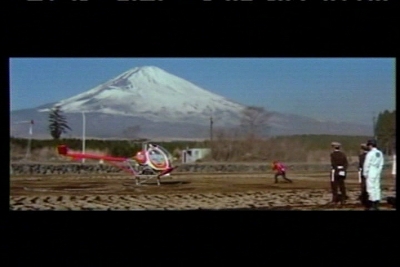
 In the far flung future of…for all intents and purposes, 1967…the Fuji Astronautical Flight Center, Japan’s answer to Cape Canaveral, prepares a sixth manned mission to Mars. The previous five met mysterious ends at the hands of equally-mysterious UFOs supposedly camped out in interplanetary space. “Your job,” a FAFC flunky tells the doomed sixth crew of gullible space monkeys, “is to determine what’s stopping us from reaching Mars.”
In the great tradition of Japanese sci-fi films from the sixties, the crew of the “nuclear powered ship” AB Gamma will fail miserably in this. However, by the time you reach the end of the film, you’ll have forgotten all about the UFO and the five crews of astronauts it allegedly obliterated. Rest assured the movie itself will have long since left such considerations dead in its wake. The X From Outer Space is a film obviously desperate to cash in on the daikaiju genre’s Silver Age, well underway at the time of its production. As the evil android, Ash, from Alien, said to his crew: “All other priorities are rescinded.” {More}
 I knew this would happen, if for no other reason than that this is the eleventh motion picture in the Star Trek franchise/canon.
 I don’t know whether Diary of the Dead was an honestly-bungled attempt to move the zombie movie forward as a format…or a flagrantly half-assed attempt to make up for Land of the Dead. I can’t see George Romaro’s heart. Anything is possible. Making a decent zombie flick only seems an impossible task thanks to my relative inexperience. Dawn of the Dead was the last great hope and that was 1978. The wave crested, and it’s been rolling back ever since we left that mall. Why can no one admit that mall was the last good idea George Romaro had? Why must we have Diary of the Dead?
 I first reviewed Falling Down on May 6th, 2000, triumphantly trumpeted as “our 150th review!” As if that were some kind of achievement. That review is still available in all its poverty and horror. It, like so many of my early reviews, deserves to be replaced, or quietly buried. (So why link to it, right? For the Internet’s sake, friend. For the Internet’s sake.)
 Most commentators believe the title refers to that elephant in the room no one wants to talk about. Director Gus Van Sant claims that it refers to that poor pachyderm from the Chinese proverb, the one getting groped by five blind men, each of whom believes he has something different under his hand. The very subjectivity of that ambiguous, titular word epitomizes Elephant‘s problems with subjectivity as a whole. By attempting to present a subjective view of one (fictional) American high school shooting Van Sant, quite unawares, paints himself into corner. So with us all.
 Conceived in the wake of Columbine and completed in 2001, Zero Day sat on a shelf for two years before it saw the light of day. Something happened in the fall of 2001, on some date I can never quite remember, despite the gnawing sensation that we, as a nation, swore never to forget. In any case, The Event (whatever it was) panicked Zero Day‘s distributors into canceling the film’s release. Undeterred, writer/director Ben Coccio used the time to do what all serious creative people do with their stalled projects: tinker. The result gained a limited release in 2003. The fact that I only heard about this film last week should tell you just how “limited.” I like to believe that, even in the midst of 2003’s War Fever, I would’ve noticed a “school shooter” movie opening up down the street. Yet, in the course of researching my next novel (goddamn that feels good to type) I’ve discovered three from that year alone. (Thanks, Variety–you industry rag, you). So here we are, with the first.
 This was one of those movies, purposely not screened for the critics in advance of its release last year. The movie industry is a vain, attention-hungry animal, and it never shies from the media spotlight without good reason. Occasionally a movie comes along so hobbled, so hackneyed, screening it for criticism becomes an open solicitation for capital-T, Trouble.
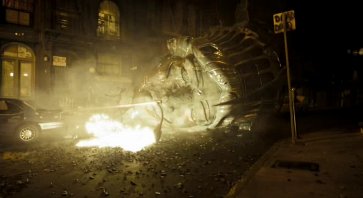 I feel remiss letting the one big budget, theatrically released daikaiju movie of 2008 pass by without comment. I have no illusions about the utility of these comments, however. Every fan on the Internet has already seen the film and come down fo’ it or again’ it. Instead, I plan to cut a path straight through the ambivalent center. My hope is this vantage point with throw Cloverfield‘s good and bad sides into stark relief allowing us to have fun. This is, after all, supposed to be entertainment. Not the Second Coming of Godzilla. Not the Third Coming of the Blair Witch (God help us if it is). Cloverfield is neither of those things, in spite (or perhaps because) of the fact that it was probably sold as such.